Cookie Consent by PrivacyPolicies.com
Showing posts with label Europa league. Show all posts

Thursday, 13 August 2020

VAR(Video assistant referee) explained

Ankit bista

Is Football Getting Slower and More Fair?

VAR explained: That's a Problem

The video assistant referee (VAR) is an assistant referee in association football who reviews decisions made by the head referee with the use of video footage and headset for communication.Following extensive trialling in a number of major competitions, VAR was first written into the Laws of the Game by the International Football Association Board (IFAB) in 2018. Operating under the philosophy of "minimal interference, maximum benefit", the VAR system seeks to provide a way for "clear and obvious errors" and "serious missed incidents" to be corrected. FIFA officially approved the use of VAR for the 2018 FIFA World Cup during the FIFA Council meeting on 16 March 2018 in Bogotá. This tournament became the first competition to use VAR in full (at all matches and in all venues).


When is VAR used?

GOALS
The role of the VAR is to assist the referee to determine whether there was an infringement that means a goal should not be awarded. As the ball has crossed the line, play is interrupted so there is no direct impact on the game.

PENALTY DECISIONS
The role of the VAR is to ensure that no clearly wrong decisions are made in conjunction with the award or non-award of a penalty kick.

RED CARD INCIDENTS
The role of the VAR is to ensure that no clearly wrong decisions are made in conjunction with sending off or not sending off a player.

MISTAKEN IDENTITY
The referee cautions or sends off the wrong player, or is unsure which player should be sanctioned. The VAR will inform the referee so that the correct player can be disciplined.

These stats were gathered by the International Football Association Board (IFAB) across a study of almost 972 games that took place in 20 different national authorities worldwide.Interestingly, across matches covered in the study, the system was only called into action in just third of the games. Approximately two-thirds of games did not revert to VAR at all, even though the facility was ready and waiting to be used. The breakdown is as follows:

  • 69.1% of matches covered did not need VAR replays
  • Only 5.5% of games where VAR was brought into play needed more than one review
  • 57.4% of VAR incidents related to penalty decisions and goals scored
  • 42.1% were in connection with red card situations
  • Mistaken identity calls were negligible 
In terms of the average VAR intervention time in a single match, it is approximately 55 seconds. This pales into insignificance with other match events such as:

  • Corner kicks - 3 mins 57 secs
  • Free kicks - 8 mins 51 secs
  • Goal kicks - 5 mins 46 secs
  • Making substitutions - 2 mins 57 secs
  • Throw-ins - 7 mins 2 secs

With so many questionable decision made by VAR. Many fans and pundits were left baffled by VAR. Everyone believes in VAR but work is needed on implementation. VAR will not achieve 100 per cent accuracy, but will positively influence decision-making and lead to more correct, and fairer, judgments. In July 2020, the International Football Association Board (IFAB) transferred the responsibility of VAR to FIFA. IFAB will continue to work closely with FIFA, especially in terms of the VAR protocol, related Laws and qualification requirements. With two different sets of referee being involved in decision making and review. Mostly the decision made initially by field referee's are not changed. The VAR may advise the referee to change his decision, but the final call must always be the referee's. With increased use of the RRA(Referee Review Area), which will be used for subjective decisions in the three key areas -goals, red cards and penalty kicks. Decision made by referees won't be full of mistakes as compared to past season.


Who is in the VAR room?

There will be a lead official, who will make judgements on all reviews. There will also be an assistant official, who continues to watch the live game while the lead handles a review. The third person is the Hawk-eye operative, who controls the technology and is independent of the decision-making process.

Verdict

It's not perfect and there's been a few mistakes or perceived errors.Anything new that's brought into the game, there's going to be teething problems.A lot of the decisions  are still subjective calls.So there's still a 50-50 on which way people go. Given time it'll come good, despite the criticism players and fans have now become more accustomed to it.

Thursday, 6 August 2020

Continental Football

Ankit bista

Two favorites reach quarter finals!!


As the business end of the season is upon us, with the fixtures coming thick and fast. Clubs have little time to prepare for, with the Europa league beginning just a weeks after domestic campaign had ended. Both the teams did not start as excepted, as it was their opponents that were the ones looking threatening.


 Inter did get a first half goal through former Manchester United striker  Lukaku, The goal from Lukaku came on a ball over the top that was defended well towards the end, but positioning allowed the Belgian striker to get a solid look on frame. The big striker bodied his defender, didn't touch the ball before the strike and put home a ball that only few goalkeepers could stop. It was an effort that shows just how much quality he has when things are clicking, and that big moment was crucial. 

Getafe didn't outplay Inter, but it came close. Far from effective, the club still had 17 shots to Inter's 10, but only two were put on frame. But it all came down to mistakes. There wasn't much that could be done on the first goal other than holding a deeper line potentially, but that's easy to say looking back. But the missed penalty kick by Jorge Molina was the nail in the coffin, Combine that with the gift from Djene to Eriksen. Substitute Eriksen was on the pitch for barely a minute before punishing Djene Dakonam's poor clearance late on. Inter will face either Bayer Leverkusen or Rangers in the final eight, with the German side leading 3-1 on aggregate.The match was played as a one-off tie in Gelsenkirchen, Germany, after the first leg was postponed due to the coronavirus pandemic.


Manchester United came from behind to beat Austrian side LASK at Old Trafford, advancing to the quarter-finals of the Europa League 7-1 on aggregate.It was tough luck on the Austrians, who were the better side in the first half, despite trailing 5-0 from their home game in March.When skipper Philipp Wiesinger curled an excellent shot into the top corner after 55 minutes, it looked like they were heading for a famous victory.But Lingard replied two minutes later and Solskjaer could even give 18-year-old defender Teden Mengi his debut as the clock ticked down to the final whistle.Anthony Martial came off the bench to score the winner four minutes from time, collecting Juan Mata's precise through ball before finishing off his 23rd goal of the season from 10 yards.


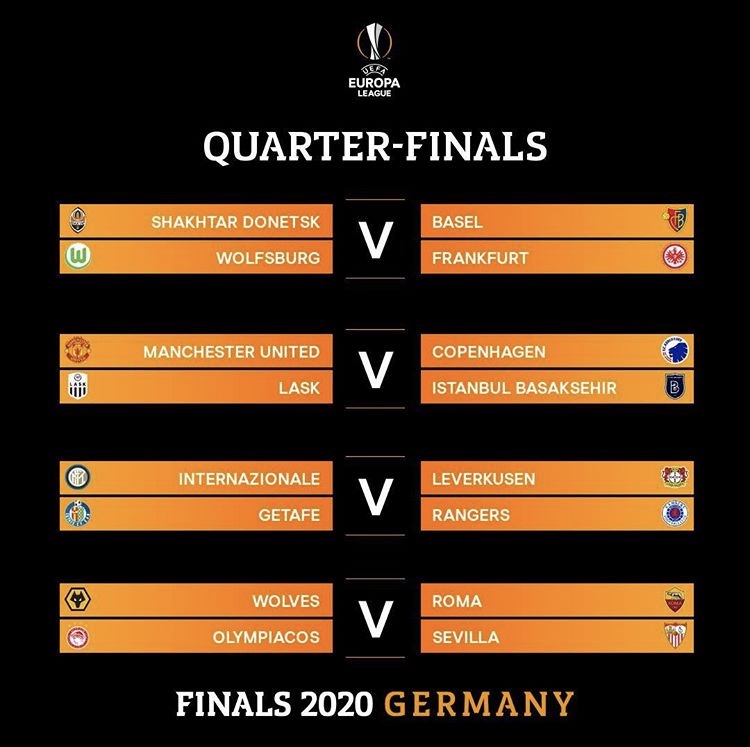
Having already secured a place in next season's Champions League, United will now play Danish side FC Copenhagen in Cologne in the quarter-finals of the 'Final 8' tournament on 10 August.The 'Final 8' is taking place in Germany, with the final itself being held in Cologne on 21 August.The draw for the remainder of the competition has already taken place. Wolves are potential semi-final opponents, so there cannot be an all-English final.Inter Milan, with three former United players - Romelu Lukaku, Ashley Young and Alexis Sanchez - are potential final opponents.

Europa League winner odds


  • Manchester United @ 17/10
  • Inter Milan @ 9/2
  • Bayer Leverkusen @ 6/1
  • Sevilla @ 7/1
  • Wolves @ 15/2
  • Roma @ 14/1

All odds provided by Paddy Power are correct at the time of publication and are subject to change.

Wednesday, 5 August 2020

European football back on cards!

Ankit bista

Back after a long hiatus!


Five months after the Champions League and Europa League were halted, European football's premiere club competition are back. Atletico Madrid's dramatic extra-time win at Anfield seems ages ago, as does Manchester United's 5-0 thrashing of LASK, with those results two of the final matches to occur before the coronavirus pandemic suspended the season.Now, with those domestic leagues and cup competitions that did return having finished, the focus is solely on Europe's elite.


PREVIOUSLY ON... THE CHAMPIONS LEAGUE AND EUROPA LEAGUE

Both the Europa League and the Champions League are at the last-16 stage, but while all 16 teams remain in the Europa League, Liverpool, Borussia Dortmund, Valencia and Tottenham are all out of Europe's premier club competition.Their conquerors - Atletico, Paris Saint-Germain, Atalanta and RB Leipzig - all won across two legs prior to pause being pressed on the campaign.Only six of the eight first legs in the Europa League happened, with four away teams - United, Bayer Leverkusen, Shakhtar Donetsk and Basel claiming advantages, while Istanbul Basaksehir beat Copenhagen 1-0 in Turkey and Wolves drew 1-1 at Olympiacos.


Let's deal with the Champions League first.

PSG and Atalanta can put their feet up knowing their quarter-final begins on August 12, the day before Leipzig face Atletico Madrid.Four last-16 ties remain and the quartet of home teams in the second leg - Manchester City, Juventus, Barcelona and Bayern Munich - will respectively host Real Madrid, Lyon, Napoli and Chelsea in their own stadiums without fans present.


That is also the case in the Europa League, though Sevilla's clash with Roma, and Inter's encounter with Getafe will now be one-off fixtures at neutral venues in Germany. Those second legs will still be played at clubs’ home stadiums before the winners head to Germany for a new knockout tournament format. All games will be played without spectators.


2019/20 UEFA Europa League schedule

5–6 August: Round of 16 (second legs at home teams’ stadiums; single-leg ties in Germany)
10–11 August: Quarter-finals (Cologne, Duisburg, Düsseldorf, Gelsenkirchen)
16–17 August: Semi-finals (German venues to be confirmed)
21 August: Final (Cologne)

2019/20 UEFA Champions League schedule

7-8 August: Round of 16 second legs (home teams' stadiums)

12-15 August: Quarter-finals (Lisbon)

18-19 August: Semi-finals (Lisbon)

23 August: Final (Estádio do Sport Lisboa e Benfica, Lisbon)


Format

This year the quarter-finals and semi-finals will be a one-off fixture and it is being played at a neutral venue

Substitution rule

The teams can now make five substitutions in the match. However, the substitution will only be allowed at three points during the match. These three occasions do not include changes at half-time, between the end of normal playing time and extra time, and at half-time during extra time. One additional substitution will also be allowed during extra time.
The number of players will also increase from 18 to 23. Earlier this was allowed just for the finals.